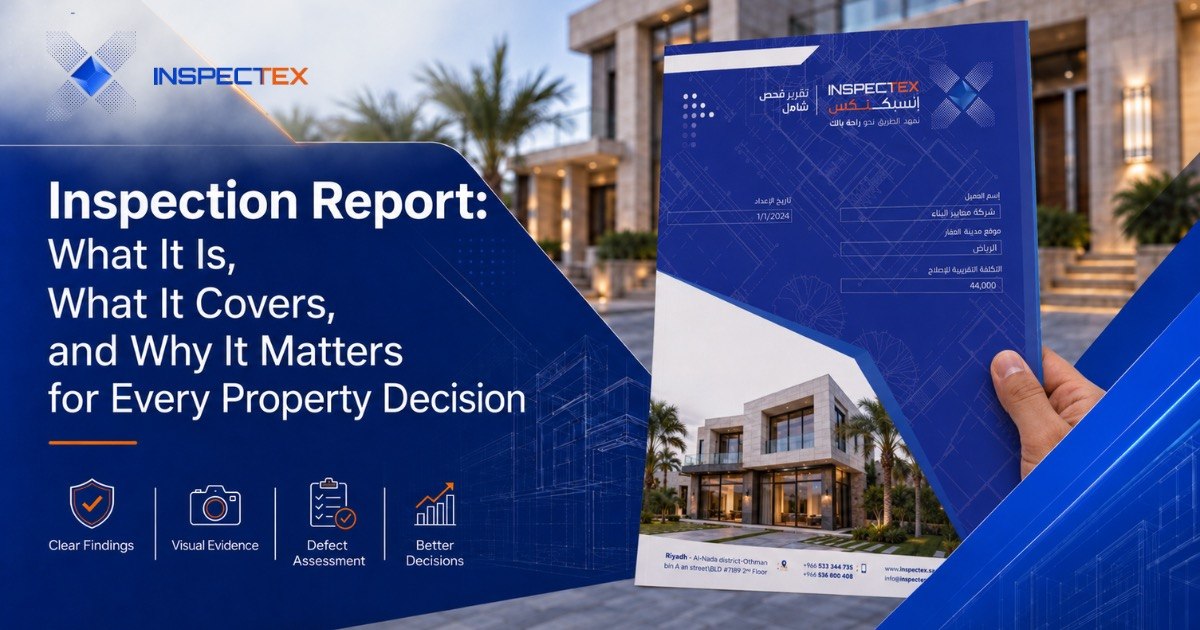
Inspection Report: What It Is, What It Covers, and Why It Matters for Every Property Decision
 Inspectex Team
كل المقالات
2026-05-31
An untested property is a financial gamble. While legal paperwork secures your title, only a rigorous property inspection reveals what is actually happening behind the paint and beneath the concrete. Within Riyadh and Jeddah, Inspectex acts as the definitive technical safeguard, translating hidden structural risks and mechanical defects into precise, actionable engineering data before you sign any contract.
What Is an Inspection Report?
A professional engineering building audit must move beyond visual impressions to deliver quantifiable, raw data about an Engineering physical condition.
Definition and Purpose of a Professional Inspection Report
- Engineering Baseline: An inspection report is a formal, multi-stage engineering document that maps the baseline structural and mechanical health of a property.
- Objective Verification: The primary purpose is to verify if the construction conforms directly to the approved architectural drawings and engineering plans.
- Code Compliance: It translates hidden physical vulnerabilities into actionable data, checking them against national safety regulations like the Saudi Building Code (SBC).
- Risk Mitigation: The document acts as a definitive risk assessment, providing immediate clarity on hidden liabilities, protecting the buyer’s capital and preventing expensive legal disputes post-handover.
The Difference Between a Site Inspection Report and a Home Inspection Report
- Phase of Assessment: A site inspection report is issued periodically during active construction to monitor quality and structural stages before details are buried beneath concrete or finishes.
- Pre-Acquisition Diagnostics: A home inspection report evaluates fully completed residential properties, focusing on immediate livability, cosmetic quality, and mechanical wear.
Key Elements of a Professional Building Inspection Report
An engineered assessment must present complex technical data in an accessible, highly structured format that is easy to navigate.
Property and Inspection Details: Date, Location, and Scope
- Property Identification: Clearly states the property type, total area, and structural configuration being inspected.
- Administrative Baseline: Records the exact date, geographical coordinates, weather conditions, and limits of the physical survey.
- Project Scope: Explicitly outlines which areas were accessed and which systems were evaluated to prevent any ambiguity about the parameters of the inspection.
Observations and Findings: What Was Examined and What Was Found
- Comprehensive Diagnostics: Documents the condition of every main system, including structural framing, electrical networks, and mechanical loops.
- Specialized Testing: Details results of non-destructive testing (NDT), identifying anomalies not visible to the naked eye.
- Comparative Analysis: Compares current site conditions with the approved design specifications to highlight execution deviations.
Risk Classification: The A to F Grading System
- Standardized Letter Grades: Systems are graded on an A-to-F scale (A for Excellent, F for Critical) with corresponding percentages to show overall structural and mechanical health.
- Color-Coded Severity: Uses distinct colors to separate minor cosmetic issues from critical failures that pose an immediate risk to the property.
- Action Prioritization: Categorizes findings into “Urgent” or “Maintenance” categories, showing the owner which repairs must be addressed immediately to ensure safety.
Supporting Evidence: Photos, Measurements, and Field Documentation
- Photographic Logs: Every single noted defect is accompanied by high-resolution photographs to serve as verifiable proof.
- Meter Readings: Includes precise measurements, such as moisture percentage inside walls, concrete compressive strength, and grounding loop resistance.
- Geospatial Mapping: Pinpoints the exact location of each issue within the building’s floor plan to make it easy for contractors to find and fix.
Recommended Actions and Remediation Timeline
- Corrective Solutions: The report does not just list problems; it provides clear, professional engineering recommendations on how to repair each defect.
- Bill of Quantities (BOQ): Offers an estimated cost of repairs for each item, calculated according to current market rates in Saudi Arabia.
- Replacement Plans: Specifies where partial or full replacement of systems is required, helping the investor plan future capital expenditures.
Types of Inspection Reports Used in Property and Construction
Different project phases require specialized technical documentation to capture specific structural and mechanical risks.
Home Inspection Report: Pre-Purchase and Pre-Sale Assessment
- Buyer Protection: A comprehensive assessment conducted before purchasing villas or apartments to uncover hidden construction defects and structural issues.
- Seller Preparation: Helps sellers identify defects beforehand, allowing them to make repairs or adjust the listing price accordingly.
- Asset Preservation: Focuses on standard residential features, ensuring all safety, electrical, and plumbing elements work reliably.
Building Inspection Report: Structural, MEP, and Compliance Findings
- Commercial Asset Scrutiny: Tailored for retail spaces, warehouses, and offices, evaluating heavy vertical loading and high-capacity central utility networks.
- Life Safety Verification: Deeply audits complex safety systems, including fire suppression, emergency egress routes, and smoke detection coverage.
- Regulatory Compliance: Assesses the building against commercial standards, making it an essential reference for asset managers and corporate buyers.
Site Inspection Report: Progress Monitoring During Construction
- Construction Milestones: Through targeted construction inspections, we document work quality during excavation, foundation pouring, column reinforcement, and structural framing.
- Concealment Protection: Ensures the structural skeleton and MEP rough-ins are verified and approved before being permanently covered by concrete, plaster, or drywall.
How to Get an Inspection Report – The Process Step by Step
Based on our own operational workflow at Inspectex, obtaining a certified, legally defensible inspection report involves the following key steps:
- Step 1: Project Booking: Contact our technical team to define the property type, total area, and structural configuration.
- Step 2: Field Deployment: A multidisciplinary team of 3 specialized engineers (Civil, Electrical, and Mechanical) arrives on-site for a thorough 3-hour physical survey.
- Step 3: Engineering Analysis: The collected field data, photographs, and technical measurements are sent to our back-office engineering department.
- Step 4: Quality Review: The inspection findings undergo a rigorous multi-stage review by a 7-member engineering team: 3 for data analysis, 3 for drafting corrective recommendations, and final approval by the technical manager.
- Step 5: Client Delivery: The final certified report is delivered to the client as a comprehensive engineering document in PDF format within 3 to 7 working days.
The 4 Core Evaluation Criteria in a Professional Report
An Inspectex audit divides a property’s condition into four distinct, highly scrutinized categories:
Environment/Site, Civil/Arch, Electrical, and Mechanical Standards
- Site and Environmental Analysis: We audit external conditions, including ambient noise levels (using sound level meters), air quality (measuring carbon monoxide and carbon dioxide with specialized EXTECH devices), and electromagnetic field (EMF) intensity.
- Civil and Structural Integrity: We inspect the foundation, load-bearing walls, slab integrity, and architectural joint performance, while looking for settlement cracks or moisture damage.
- Electrical Systems Audit: Our engineers inspect electrical distribution boards, test insulation resistance, verify grounding loops (using Earth clamp testers), and check load balance to prevent fire hazards.
- Mechanical and Plumbing Assessment: We perform pressure tests on supply lines, use sewer cameras to inspect drainage pathways, and analyze HVAC performance to ensure system efficiency.
What Makes an Inspection Report Legally and Financially Credible?
- SBC Alignment: The report must align directly with the Saudi Building Code (SBC) and international building standards (such as ASTM and NEC).
- Accredited Personnel: Inspections must be performed by licensed, specialized engineers registered with the Saudi Council of Engineers (SCE).
- Third-Party Independence: The inspecting firm must have zero financial interest in the real estate transaction, guaranteeing an objective, unbiased assessment.
- Rigorous Quality Control: The document must pass a multi-stage review process to ensure its technical accuracy stands up to bank or court scrutiny.
Common Mistakes That Undermine a Report on the Inspection’s Value
A poorly structured assessment can expose the property owner to unforeseen operational liabilities.
Vague Language, Missing Evidence, and Incomplete Findings
- Subjective Phrases: Using vague terms like “satisfactory condition” instead of giving precise engineering measurements and dimensions.
- Lack of Evidence: Failing to back up a noted defect with high-resolution photos or technical meter readings.
- Poor Structure: Failing to reference the specific building code clause being violated, making the report useless for contractor accountability.
Inspectex Inspection Reports – Certified Engineering Documentation for Saudi Arabia
In the rapidly growing markets of Riyadh and Jeddah, technical precision is the only way to manage real estate risk.
What the Inspectex Report Covers: Structural, Electrical, Mechanical, and Environmental
- Exhaustive Property Check: We cover over 1000 technical points on every property, examining everything from foundation settlement to indoor air quality.
- Multidisciplinary Expertise: Every site visit is conducted by three specialized engineers, ensuring no system is assessed outside its respective field.
- SBC-Compliant Auditing: We evaluate all systems against the Saudi Building Code (SBC) to ensure total regulatory compliance.
SBC INSP 0009 Certified Reports Accepted by Banks, Courts, and Regulatory Bodies
- Official Recognition: Our reports comply with SBC INSP 0009 standards, making them highly recognized by financial institutions, judicial bodies, and municipal authorities.
- Actionable BOQ: Every report includes exact defect locations, priority levels, estimated repair costs, and clear replacement plans.
- 10-Year Archiving: We maintain a secure digital archive of your technical data for a minimum of ten years, providing a permanent record of the building’s history.
How to Get an Inspection Report from Inspectex in Riyadh and Jeddah
Contact our team before buying, leasing, or during construction to secure your engineering audit and receive your findings within 3 to 7 working days, delivered in a highly comprehensive report.
Frequently Asked Questions About Inspection Reports
What Is the Inspection Report?
An inspection report is a certified engineering document detailing a building’s structural, civil, electrical, and mechanical status, supported by objective measurements and cost estimates.
What Are the Core Evaluation Criteria in the Report?
The report grades the asset across four main standards: Site/Environment, Civil/Structural, Electrical, and Mechanical systems, using a letter grade scale.
How to Get an Inspection Report?
You can book your technical audit by contacting Inspectex. Our specialized engineering team will perform the field survey, and you will receive the final report within 3 to 7 working days.
Need a Certified Inspection Report for Your Property? Request One from Inspectex Today
Do not leave your real estate decisions to visual impressions. Inspectex eliminates the guesswork in Riyadh and Jeddah by providing a certified, SBC-compliant inspection report that details every hidden defect and estimates the repair cost.
Book your professional inspection with Inspectex today, and step into your next property transaction with absolute engineering certainty.
